Kelly-kriteriet og rulett
Kelly-kriteriet fortel ein spelar med ein fordel kor mykje han bør satse. For rulett gjev det eit klart svar: ingenting.

Kelly-innsats = fordel / odds. Med negativ fordel gjev formelen ein negativ del, og det tyder: ikkje sats. Kriteriet er likevel nyttig for å forstå kvifor skeivheitsspelarar dimensjonerte innsatsane slik dei gjorde, og kvifor alle andre bør fastsetje innsatsen ut frå budsjettet.
Kriteriet
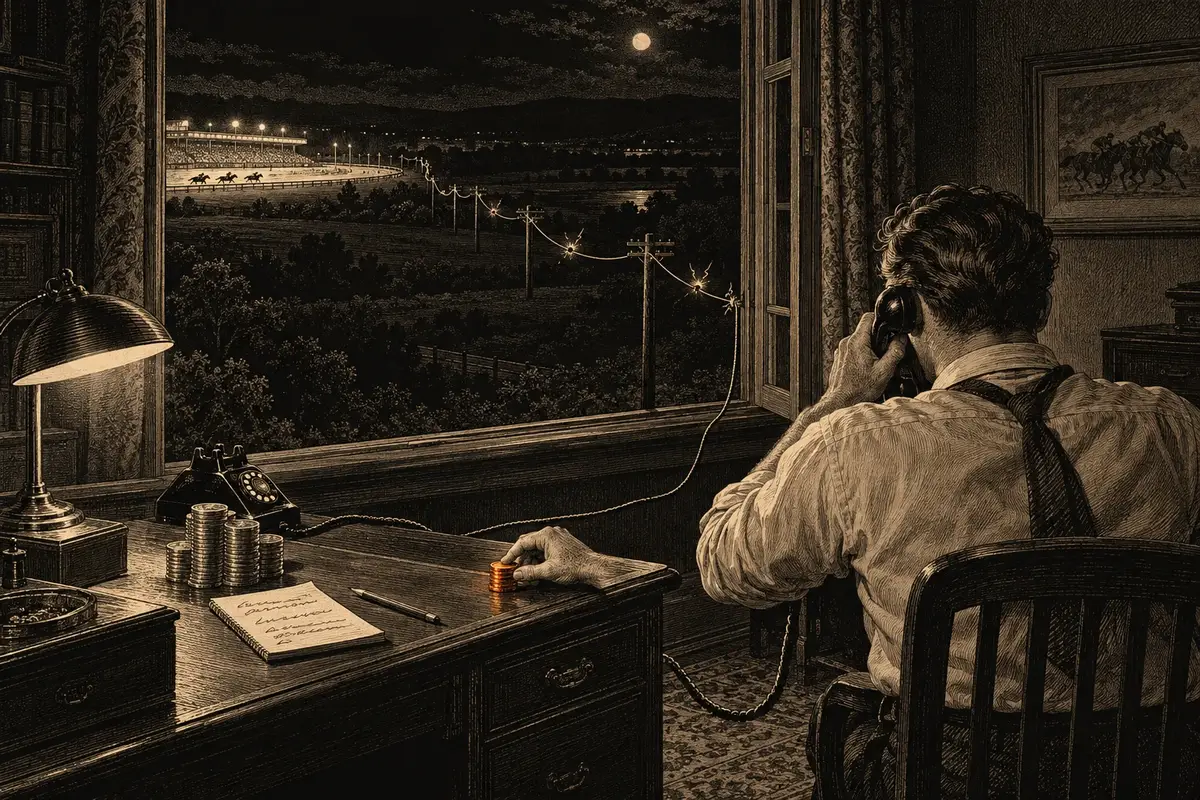
John Kelly (1956) asked how a gambler with a known edge should size bets to maximize long-run growth of the bankrollpengarSpelekasseDet samla beløpet som er sett av til spel. Styring av spelekassa er å avgjere kor mykje av ho du risikerer per innsats og per økt.Les heile →. The answer, for a bet paying b to 1 with win probabilitymatematikkSannsynKor sannsynleg eit utfall er, frå 0 til 1 eller frå 0% til 100%. Eitt tal: 1/37 = 2,70%.Les heile → p and loss probability q = 1 − p, is to stake the fraction f* = (bp − q) / b of the bankroll. Positive f* means bet that fraction; zero or negative means do not bet. Kelly worked at Bell Labs, and his paper, “A new interpretation of information rate”, set the problem in Claude Shannon’s theory of information: a gambler who gets tips over a noisy line, at fair odds, can grow the bankroll at best at the rate the line carries information. This is a growth objective under a probability model, not a promise to finish ahead after a particular number of bets. A spending limit, finite deadline or payoutpengarUtbetalingDet ein vinnande innsats gjev tilbake, oppgitt som «X til 1» i tillegg til den returnerte innsatsen.Les heile → cap changes the decision problem.
Kelly-innsats i rulett
For redinnsatsRaudt1:1-innsats på dei 18 raude tala. Fransk: rouge.Les heile →: b = 1, p = 18/37, q = 19/37; f* = (18/37 − 19/37)/1 = −1/37. For a straight upinnsatsEnkelttalEitt enkelt tal, betaler 35:1.Les heile →: b = 35, p = 1/37, q = 36/37; f* = (35/37 − 36/37)/35 = −1/1295. Every standard bet gives a negative Kelly fraction, because every bet has a negative edge, and the growth-optimal stake is zero. Kelly betting on roulette is a formal way of saying what the house-edge page says: no positive stake maximizes expected logarithmic growth when the bet has negative expectation. A particular session can still end in profit. La partageregelLa partageFransk regel: Når nullen kjem, får du tilbake halvparten av ein 1:1-innsats. Halverer husfordelen på desse innsatsane til 1,35%.Les heile → needs a separate three-outcome calculation: a win, a full loss or a half-loss on zerohjulNullDen eine grøne lomma som ingen 1:1-innsats, dusininnsats eller kolonneinnsats dekkjer; kjelda til husfordelen. Òg: enkeltnull, 0.Les heile →. Its expected log growth also falls as the stake increases from zero.
Der Kelly galdt
Suppose a pocketutstyrLommeEitt av dei 37 nummererte romma på rotoren. Òg: spor, kopp.Les heile → really has a stable, known probability of 1 in 30 and pays 35 to 1. The Kelly fraction is 0.57%: about $57 from a $10,000 bankroll. Under independent spinsmatematikkUavhengige spinnKvart spinn har dei same sannsyna same kva historikken er. Grunnlaget for kvar utrekning på denne nettstaden.Les heile → and exact fractional staking, the geometric growth factor over 1,000 spins is about 1.7. Expected bankroll grows faster because rare large wins pull up the average. These are model calculations, not evidence that any named historical player used Kelly or achieved this result.
Typisk og gjennomsnittleg
The gap between the typical bankroll and the average one is wide. Take a pocket that hits 1 time in 25, a hypothetical edge of 44% per unitpengarEiningGrunninnsatsen eit system eller ein spelar reknar i. Progresjonar blir skildra i einingar, slik at dei gjeld ved kva bord som helst.Les heile → staked. Kelly stakes 1.26% of the bankroll on it. After 1,000 spins the typical bankroll has grown about 11.5 times, while the average, pulled up by a few very lucky runs, has grown about 249 times. Betting more than Kelly raises the average and lowers the typical result: at twice the Kelly stake the typical bankroll only doubles, and by two and a half times the Kelly stake it shrinks, although every bet still carries a 44% edge. In this example, half-Kelly retains about 78% of the expected log growth. This fraction depends on the probabilities and payout.
Når fordelen er ei gjetting
Kelly uses the true probabilities, but a player usually has only estimates. Selecting the busiest pocket from a past record creates a selection problem: even a fair wheel has a busiest pocket. Its observed rate can overstate its future probability. Choosing the stake from that same record compounds the error. An independent follow-up sample helps test a proposed bias (see How to Detect Roulette Wheel Bias). Reducing the calculated fraction reduces exposure, but cannot turn a false edge into a real one.
Folk med ein fordel
Haghani and Dewey (2016) studied 61 participants given $25 and 30 minutes to bet on a simulated coin with a disclosed 60% chance of heads. The payout cap was $250; its value was revealed when a proposed winning bet would reach it. Their reported 21% success category included balances of at least $200, while the 28% “bust” category meant less than $2, not necessarily zero. Eighteen participants bet their entire balance on one flip. The uncapped Kelly fraction is 20%, but the cap and deadline change the optimization problem. The experiment illustrates how stake choices matter even with a known advantage; it does not establish one best strategy for every objective.
Kva du kan bruke i staden
Utan ein fordel er dimensjonering eit spørsmål om budsjett, ikkje om vekst: innsats = det du er villig til å bruke per spinn, utleidd frå timebudsjettet og tempoet ved bordet (sida Styring av spelekassa). Det Kelly gjev den vanlege spelaren, er eit klart svar: null. Alt du satsar over null, er prisen for å spele, vald av deg, ikkje optimalisert av nokon formel.
Ei merknad om brøk-Kelly og «pengestyring»
Betting a fixed percentage of the current bankroll is proportional staking: the stake rises after wins and falls after losses. Flat bettingstrategiFast innsatsÅ satse same beløp kvart spinn. Grunnlinja som kvar progresjon blir samanlikna med.Les heile → instead keeps the cash stake fixed. Neither creates an edge on ordinary roulette. With infinitely divisible stakes and a fraction below 100%, proportional staking never reaches exactly zero in finitely many losses, but the balance can become arbitrarily small. Real table minimums can prevent further play much sooner. The growth-optimal fraction remains zero.
Formel
Spørsmål
Only when the actual probabilities, payouts and conditions give a credible positive advantage. Standard bets on an unbiased wheel have no such advantage.
Using half the calculated fraction reduces exposure to errors in the estimated edge. The familiar three-quarters-growth rule is an approximation for small advantages, not a universal identity. It does not protect against an edge that does not exist.
Nei. Kelly optimaliserer vekst når du har ein fordel. Styring av spelekassa kontrollerer forbruket når du ikkje har nokon.
Matte for moro skuld
Prøv sjølv først. Kvar løysing er bretta saman; opne ho når du er klar.
Suppose a hypothetical bet on one number has a known 44% edge under standard payoutspengarUtbetalingDet ein vinnande innsats gjev tilbake, oppgitt som «X til 1» i tillegg til den returnerte innsatsen.Les heile → and independent spinsmatematikkUavhengige spinnKvart spinn har dei same sannsyna same kva historikken er. Grunnlaget for kvar utrekning på denne nettstaden.Les heile →. Kelly gives a 1.26% bankrollpengarSpelekasseDet samla beløpet som er sett av til spel. Styring av spelekassa er å avgjere kor mykje av ho du risikerer per innsats og per økt.Les heile → fraction. What if the same 44% edge came on one bet spread over five neighboring numbers?
Vis løysinga
Svar Då seier Kelly 7,1% av spelekassa, og spelekassa veks nesten seks gonger så fort: om lag 1,25 millionar gonger over 1 000 innsatsar, mot om lag 11,5 gonger.
A straight upinnsatsEnkelttalEitt enkelt tal, betaler 35:1.Les heile → with a 44% edge wins with chance 0.04, since 36 × 0.04 = 1.44. Kelly’s stake is the edge divided by the odds: 0.44/35 = 1.26%. The typical growth per bet is 0.04 × ln(1 + 35 × 0.0126) + 0.96 × ln(1 − 0.0126) ≈ 0.00244, so 1,000 bets multiply the bankroll by about e^2.44 ≈ 11.5.
Spread one stake over five numbers and the bet wins with chance 0.20 and pays 36/5 for 1, that is 6.2 to 1: still a 44% edge, since 0.2 × 7.2 = 1.44. Kelly’s stake becomes 0.44/6.2 = 7.10%, and the growth per bet 0.01404, about 5.75 times as much. Over 1,000 bets that is e^14.04, about 1.25 million.
The edge is the same; the swings are smaller. A bet that wins one time in five has a larger growth-optimal fraction in this model, although losses can still reduce the bankroll severely. This comparison assumes the same known edge for both bets; actual predictions need independent evidence.
Assume two numbers are adjacent on the betting layoututstyrSpelefeltDet trykte rutenettet for innsatsar på bordet. Òg: bord, filt, duk.Les heile → and each has a stable, known probabilitymatematikkSannsynKor sannsynleg eit utfall er, frå 0 til 1 eller frå 0% til 100%. Eitt tal: 1/37 = 2,70%.Les heile → of 1 in 25 on independent spins. Compare a splitinnsatsSplitTo tal som ligg inntil kvarandre, betaler 17:1.Les heile → between them at 17 to 1 with equal straight-up stakes on the two numbers. How much does Kelly say, and how fast does the bankroll grow compared with one such pocketutstyrLommeEitt av dei 37 nummererte romma på rotoren. Òg: spor, kopp.Les heile →?
Vis løysinga
Svar Det gjer ingen skilnad: 2,59% av spelekassa på splitten, eller 1,29% på kvart tal. Den typiske spelekassa veks om lag 155 gonger på 1 000 spinn, mot 11,5 gonger med éi lomme.
The split wins with probability 2/25 = 0.08 and pays 17 to 1, so it returns 18 × 0.08 = 1.44 per unitpengarEiningGrunninnsatsen eit system eller ein spelar reknar i. Progresjonar blir skildra i einingar, slik at dei gjeld ved kva bord som helst.Les heile → staked: an edge of 44%, the same as one biased pocket. Kelly’s stake is the edge divided by the odds: 0.44/17 = 2.59%.
Two straight-up bets of 1.29% each give exactly the same results. When either number comes up, one chippengarSjetongEit merke som representerer eit fast beløp, og som blir plassert på spelefeltet for å gjere ein innsats. Òg: cheque.Les heile → wins 35 to 1 and the other is lost, a net of 34 × 1.29% = 44% of the bankroll, as the split pays; when neither does, both are lost.
The growth per spin is 0.00505, against 0.00244 for one pocket, so over 1,000 spins the typical bankroll grows e^5.046 ≈ 155 times rather than e^2.44 ≈ 11.5 times. The geometric growth factor is larger because the combined bet wins more often at the same 44% edge. It is a model result, not a guaranteed bankroll.
Komisk avbrot
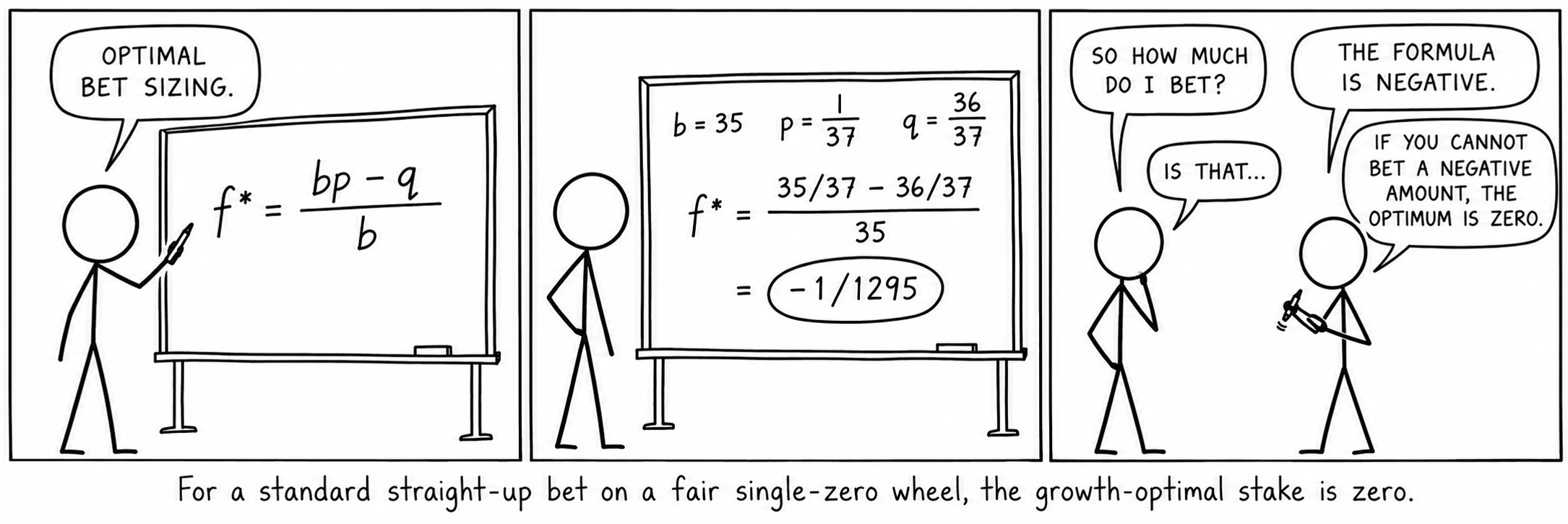
Den vekstoptimale rulettinnsatsen er eit tal alle allereie kjenner.
Kjelder
- Kelly, J. L. “A new interpretation of information rate.”
- Breiman, L. “Optimal gambling systems for favorable games.”
- Thorp, E. O. “Optimal gambling systems for favorable games.”
- Thorp, E. O. The Mathematics of Gambling.
- Epstein, R. A. The Theory of Gambling and Statistical Logic, 2nd ed.
- Taylor, D. G. Games, Gambling, and Probability: An Introduction to Mathematics, 2nd ed.
- Ethier, S. N. The Doctrine of Chances: Probabilistic Aspects of Gambling.
- Haghani, V. & Dewey, R. “Rational decision-making under uncertainty: observed betting patterns on a biased coin.”